

Shades On, Every Time: The Real Reason Eye Protection Matters When You Tan
UV eye damage is one of the most underestimated risks in tanning — yet it’s one of the easiest to prevent. Whether you’re spending an afternoon outdoors or stepping into a sunbed, wearing the right eye protection isn’t optional; it’s one of the simplest ways to protect your long-term health.
Most of us know sunglasses are important in a vague, general sense. Fewer people understand the specific mechanism by which UV radiation harms the eye, what the consequences actually look like, and what “good” eye protection genuinely means. This guide covers all of it — clearly, practically, and without unnecessary alarm.
Why Your Eyes Are Particularly Vulnerable to UV Radiation
Your skin has several layers of defence against UV radiation: melanin production, the stratum corneum, and the body’s natural repair mechanisms. Your eyes have far fewer. The cornea — the transparent front surface of your eye — and the lens sit directly in the path of UV rays, with limited biological shielding.
The World Health Organisation (WHO) identifies UV radiation as a significant risk factor for several eye conditions, noting that both UVA and UVB rays penetrate different structures of the eye and cause different types of damage over time. Unlike some UV-related skin changes, eye damage accumulates silently. You won’t notice it happening in real time, which is part of what makes consistent protection so important.
It’s also worth noting that your eyes can be exposed to UV even when the sky looks overcast. UV rays penetrate cloud cover, and reflective surfaces — water, sand, snow, even concrete — can significantly increase your total exposure. On a sunbed, UV output is concentrated and consistent, making the case for indoor tanning eyewear even stronger.
What Happens When Your Eyes Are Exposed to UV Without Protection?

Photokeratitis: The Immediate Response
Photokeratitis, in simple terms, is a sunburn of the eye’s surface. It affects the cornea and conjunctiva — the thin membrane covering the white of your eye — and tends to appear several hours after UV exposure, often when you’re no longer expecting it.
It can be caused by intense outdoor UV exposure (particularly at altitude or near water), but it is also a recognised risk for those using sunbeds without proper eye protection. Symptoms include:
• A gritty or sandy sensation in the eyes
• Redness and inflammation
• Heightened sensitivity to light
• Blurred or temporarily reduced vision
• Watering eyes and swelling of the eyelids
These symptoms typically resolve within 24 to 48 hours without lasting damage — but that’s in isolated incidents. Repeated exposure, even at lower intensities, creates cumulative stress on the eye’s tissues that adds up over time.
Cataracts: The Long-Term Concern
Cataracts — the progressive clouding of the eye’s natural lens — are the leading cause of blindness worldwide, according to the WHO. UV-B radiation is an established environmental risk factor. A landmark study published in the journal Ophthalmology found that people with higher cumulative UV exposure had a significantly greater risk of developing cortical cataracts, one of the most common subtypes.
The good news is that cataracts are largely preventable through consistent UV protection. Wearing UV-blocking sunglasses outdoors and compliant tanning goggles during sunbed sessions are among the most practical steps you can take to reduce your lifetime UV dose.
Macular Degeneration
Age-related macular degeneration (AMD) affects the central portion of the retina and is a major cause of vision loss in adults over 50. Research published in various ophthalmic journals has explored the relationship between UV and blue-light exposure and AMD risk, though the scientific picture remains incomplete. What is clear is that long-term UV exposure is not without consequence for retinal health, and reducing unnecessary exposure is sensible practice regardless of the current evidence base.
Pterygium and Pinguecula
These are fleshy, non-cancerous tissue growths that develop on the surface of the eye. Pterygium (sometimes called “surfer’s eye”) is directly associated with prolonged exposure to UV light, particularly in sunny or reflective environments. While not usually sight-threatening, both conditions can cause chronic irritation and, in severe cases, may require surgical treatment
Wearing Sunglasses Outdoors: More Than a Fashion Choice
A quality pair of sunglasses rated UV400 blocks all wavelengths of UV radiation up to 400 nanometres, covering both UVA and UVB. This is the standard to look for. The darkness of the lens tells you very little about UV protection — a clear lens can offer full UV blocking, while a heavily tinted lens without the appropriate coating may block light but still transmit UV radiation.
For the best coverage, choose sunglasses with larger lenses or a wraparound design. UV enters the eye not only from directly in front of you, but also from the sides and from reflections off the ground — a factor that standard small-frame sunglasses don’t fully account for.
Polarised lenses reduce glare effectively (particularly useful near water or snow), but polarisation is not the same as UV protection. Check that any pair you buy specifically states UV400 or “100% UV protection.” If the label only mentions polarisation, it may not be providing the UV blocking your eyes need.

Indoor Tanning Eyewear: What You Need to Know About Sunbed Safety
Sunbed safety guidance in the UK is clear: eye protection must be worn during every sunbed session. Standard sunbeds emit UV radiation at intensities that can far exceed natural sunlight exposure, and the enclosed environment means your eyes have nowhere to escape it. Closing your eyes, using a towel, or placing your hands over your face provides negligible protection and should never be treated as a substitute for proper indoor tanning eyewear.
Why Closed Eyes Are Not Enough
The eyelid is the thinnest skin on the human body, typically around 0.5mm. While it effectively blocks visible light to feel comfortable, research has shown that the eyelids transmit a meaningful proportion of UVA radiation. A study in the journal Photochemistry and Photobiology found that eyelids offered only partial UV filtration — far below the level required for safe tanning sessions.
If you’ve ever noticed your eyes feeling dry, red, or sensitive after a sunbed session without goggles, that’s not a coincidence. It’s a sign that UV exposure reached your eyes, and the damage — while it may have felt minor — was real.
What to Look For in Tanning Goggles
In the UK, compliant tanning eye protection should meet recognised standards for UV filtration. When choosing your indoor tanning eyewear, look for the following:
• UV certification — verify the product meets EN 170 (UV filters) or equivalent standards
• A close, flush fit — gaps around the edge allow UV to reach the eye; well-fitting goggles sit securely against the socket
• Comfortable, skin-friendly materials — particularly important if you tan regularly
• Minimal contact area — modern tanning winkies are designed to be as slim as possible to reduce tan lines around the eyes
The “raccoon eyes” concern is among the most common reasons people skip wearing eye protection. It’s worth knowing that today’s tanning winkies are designed specifically to minimise this — they’re far smaller and lower-profile than the goggles of ten or twenty years ago. Rotating their position slightly between sessions can help further reduce any visible marking.
How to Minimise Tan Lines Around Your Eyes
If you’re conscious about how to avoid tan lines on your eyes, there are a few practical steps worth building into your routine:
• Choose the smallest, most flush-fitting goggles or winkies available
• Rotate the angle of your eye protection slightly between sessions to vary the coverage area
• Ensure you’re using an even, well-applied tanning accelerator to help blend any transition around the eye area
• Consider gradual session lengths rather than extended exposure — shorter, more frequent sessions support an even tan with less pronounced contrast
Any residual eye area contrast will fade naturally as your tan develops across your face. It’s a minor and manageable consideration when weighed against the alternative.
Recognising the Symptoms of Eye Sunburn
Knowing the symptoms of eye sunburn — photokeratitis — means you can respond quickly if exposure does occur. They typically appear between two and twelve hours after unprotected UV exposure and may include:
• A persistent feeling of grit or sand in the eye
• Redness across the white of the eye
• Sensitivity or pain when exposed to bright light
• Blurred vision
• Excessive watering or discharge
• Swelling or puffiness around the eyelid
Most cases of mild photokeratitis resolve within 24–48 hours with rest in a darkened environment, cool compresses, and lubricating eye drops available from any pharmacy. If symptoms are severe, persist beyond 48 hours, or involve significant vision changes, seek advice from a GP or optician promptly.
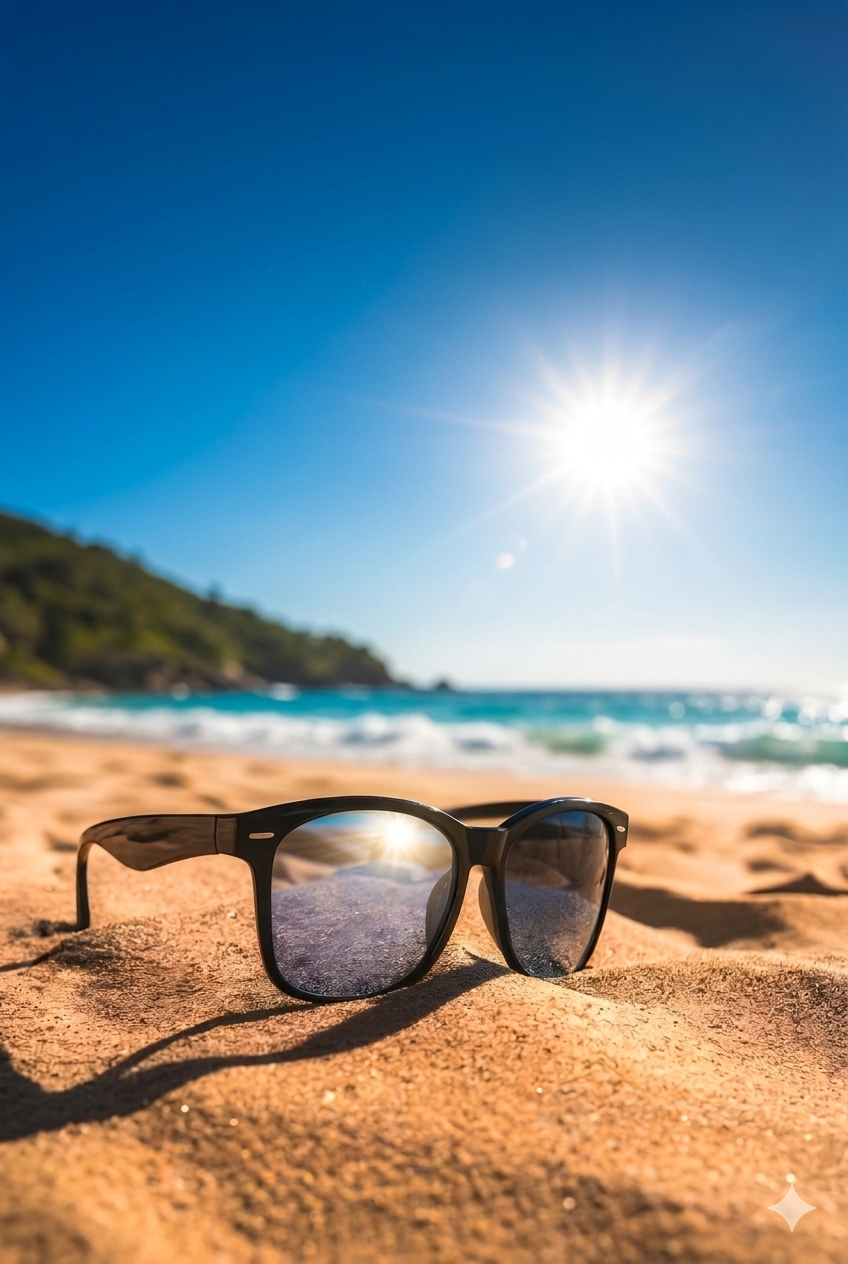
Choosing the Best Eye Protection for Tanning: A Simple Summary
Whether you’re tanning outdoors or on a sunbed, the core principles are the same:
• Outdoors: UV400-rated sunglasses, worn consistently — not just on bright days
• Sunbed: compliant tanning goggles or winkies, every single session, no exceptions
• Both: check that UV protection is explicitly stated on the product — don’t assume
• Replace your eye protection regularly — UV-blocking coatings can degrade over time, particularly with regular use
Eye protection is one of the lowest-effort, highest-impact things you can do for your health as a regular tanner. It takes 10 seconds to put on goggles before a sunbed session, and the long-term benefits are significant.
Tanning Well Means Tanning Thoughtfully
At TanTrap, our approach is built around the idea that a great tan and good sense aren’t mutually exclusive. Our peptide-enhanced tanning accelerators are designed to help you achieve a deeper, more even, natural-looking tan while reducing the amount of UV exposure needed to get there. Less time under UV to achieve the same result means less cumulative exposure — for your skin and your eyes.
That said, no tanning accelerator replaces the need for protective measures. Our products do not contain SPF and are not designed for sun protection — they help your skin’s natural melanin-activating process work more efficiently. Responsible tanning always means pairing your accelerator with appropriate UV eye protection and, where needed, an SPF product for your skin.
Discover Our Peptide-Enhanced Tanning Range
Browse TanTrap’s full range of tanning accelerators at tantrap.com — including our Peptide Tanning Accelerator Lotion, Intensive Tanning Gel, and Melanin Boost Ultra Dark formula. Each product is developed with Octapeptide-5 technology to support your skin’s natural melanin production, helping you build a sun-kissed glow with less UV exposure.
Pair your chosen accelerator with compliant UV eye protection, and you’ve covered the essentials for a session that’s both effective and sensible.
Discover our range at tantrap.com
References
1. World Health Organisation (WHO). (2022). Ultraviolet radiation and health. WHO. https://www.who.int/news-room/fact-sheets/detail/ultraviolet-radiation
2. Cruickshanks, K.J., et al. (1992). The association of sunlight exposure and nuclear cataracts in the Beaver Dam Eye Study. Ophthalmology, 99(11), 1770–1778. https://doi.org/10.1016/S0161-6420(92)31745-X
3. Coroneo, M.T. (1993). Pterygium as an indicator of UV exposure: reflections and speculations. British Journal of Ophthalmology, 77(11), 734–739. https://doi.org/10.1136/bjo.77.11.734
4. Kolozsvári, L., et al. (2002). UV absorbance of the human cornea in the 240- to 400-nm range. Investigative Ophthalmology & Visual Science, 43(7), 2165–2168. PMID: 12091412
5. Perugini, P., et al. (2002). Eyelid UV transmittance in cosmetic formulations. Photochemistry and Photobiology, 75(1), 48–52. https://doi.org/10.1562/0031-8655(2002)075<0048:EUVTCP>2.0.CO;2
6. British Standards Institution. (2002). BS EN 170:2002 Personal Eye Protection — Ultraviolet Filters — Transmittance Requirements and Recommended Use. BSI.